
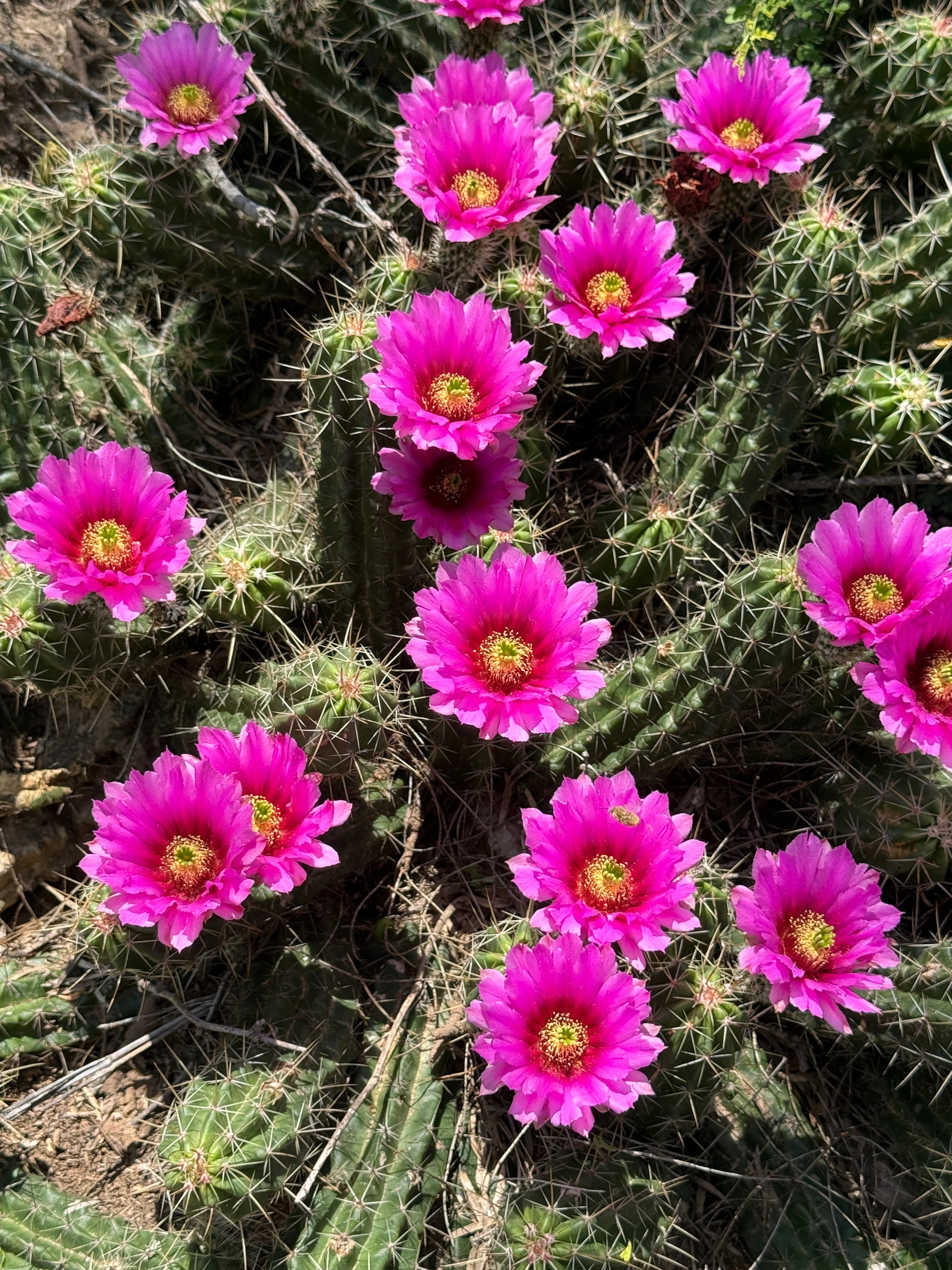
 A Transformation in the Desert
Known scientifically as *Echinocereus enneacanthus*, the Strawberry Hedgehog Cactus is one of the most striking native cacti found across South Texas and much of the American Southwest. It thrives in environments that challenge nearly every other plant—sun-scorched ground, low rainfall, alkaline or rocky soils, and wide swings in temperature from day to night.
You’ll often find it growing low to the ground in clusters, made up of cylindrical stems covered in dense, protective spines. These clusters can slowly spread over time, forming small colonies that blend almost seamlessly into the landscape. For most of the year, the plant appears quiet—almost dormant—its energy stored deep within thick, water-holding tissues that allow it to survive long periods without rain.
But beneath that still exterior, something is building.
The Strawberry Hedgehog Cactus follows a seasonal rhythm shaped by the land itself. Its bloom is typically triggered in early to mid-spring, often after winter moisture and warming temperatures signal that conditions are right. In South Texas, this can vary year to year depending on rainfall patterns and subtle shifts in climate—making each bloom season a little unpredictable.
And then, almost overnight, the transformation begins.
Large, funnel-shaped flowers emerge from the sides or tops of the stems, unfolding into vivid displays of color—most commonly bright magenta or deep pink, sometimes with lighter centers that appear almost luminous in the sunlight. These blooms can measure anywhere from 2 to 4 inches across, dramatically larger than the cactus stems themselves.
What makes this even more remarkable is how quickly it happens.
A plant that looked unremarkable just days before suddenly becomes one of the most eye-catching features on the ranch. It’s not gradual—it’s immediate, almost like the desert revealing something it’s been holding back.
These flowers are not just beautiful—they serve an essential purpose.
The bright coloration and open shape are designed to attract pollinators, especially native bees and other insects that are active during the spring bloom period. The cactus produces nectar and pollen during this short window, relying on these visitors to transfer pollen between flowers so that fruit can develop later in the season.
Because the bloom period is so brief, timing is critical.
The flowers typically open during the day and may close at night, repeating this cycle for only a few days before wilting. Heat, wind, and dry conditions can shorten that window even further. In some cases, a full bloom can come and go in less than 72 hours.
It’s a narrow opportunity—for the plant, for pollinators, and for anyone lucky enough to witness it.
Beyond its beauty, the Strawberry Hedgehog Cactus plays an important role in the ecosystem. Its flowers provide an early-season food source for pollinators, and its later fruit supports wildlife, including birds and small mammals. Even its structure offers shelter and protection in the open landscape.
This is not just a plant surviving in harsh conditions—it’s a plant actively contributing to the life around it.
And that’s what makes the transformation so powerful.
It’s not just about a bloom.
It’s about resilience turning into beauty.
It’s about timing, survival, and connection to the land.
It’s about something that spends most of its life unnoticed…
suddenly becoming unforgettable.


